The best AI tool for creating a video depends on what you already have. A recorded interview needs an editor. A text prompt needs a generator. A campaign assembled from a script, stock media, voiceover, and captions needs a production workflow that can coordinate several steps.
This guide compares ten current tools by those jobs. It uses the linked product pages and documentation rather than claiming a same-prompt or same-footage test that was not recorded. Free allowances and prices were checked on each vendor’s official page on November 4, 2026; they change often, so verify before committing a production workflow.
The short answer
- Editing footage you already recorded: ChatCut
- Generative creative projects with a timeline: Runway
- Veo-based filmmaking and scene creation: Google Flow
- Adobe generation and browser timeline editing: Adobe Firefly
- Prompt-to-video production using agents and multiple models: Invideo
- Design-led social video and short generated clips: Canva
- Editing speech by editing the transcript: Descript
- Turning long videos into short clips: OpusClip
- Presenter videos with an AI avatar: HeyGen
- Training and business videos from documents: Synthesia
These are workflow matches, not measured winners. Test the finalists with the same source material, prompt, aspect ratio, and export requirements.
AI video tools compared
| Tool | Starts from | Platform | Free allowance | Paid from (US) |
|---|---|---|---|---|
| ChatCut | Your footage, a prompt or a product page | macOS, Windows, web, AI agents | Editor, transcription and captions; 60 min of cloud exports | $25/month or $252/year |
| Runway | A prompt, image or short clip | Web | 125 one-time credits; free videos watermarked | $15/month or $12/month billed annually |
| Google Flow | A prompt, frames or references | Web (desktop Chromium recommended) | Daily credits for eligible accounts | Google AI plan; check your region |
| Adobe Firefly | A prompt or uploaded media | Web | Limited free generations | $9.99/month (2,000 credits) |
| Invideo | A script, brief or footage | Web | Limited weekly credits | $20/seat/month, 400 credits |
| Canva | A template or design | Web, desktop, mobile | Free plan; clip generation on eligible tiers | $18/month or $144/year |
| Descript | Recorded speech | macOS, Windows, web | 60 media min/month at 720p, 100 one-time AI credits | $24/month or $16/month billed annually |
| OpusClip | A long video or link | Web | 60 credits/month, watermark, no editing | $15/month |
| HeyGen | A script and an avatar | Web | 3 watermarked videos/month, up to 1 min each | $29/month |
| Synthesia | A document or script | Web | 10 minutes/month with watermark | $19/month |
Monthly figures marked “billed annually” assume a year paid up front. AI generation in most of these tools uses credits that can run out before the month ends.
AI video editor, generator, or production platform?
An AI video editor changes existing footage. It may transcribe speech, remove selected pauses or filler words, arrange clips, create captions, clean audio, or apply edits from a prompt. A useful editor keeps the result reviewable in a transcript or timeline.
An AI video generator creates new footage from text, images, reference media, or other instructions. It solves a different problem from cutting an interview or tutorial you already recorded.
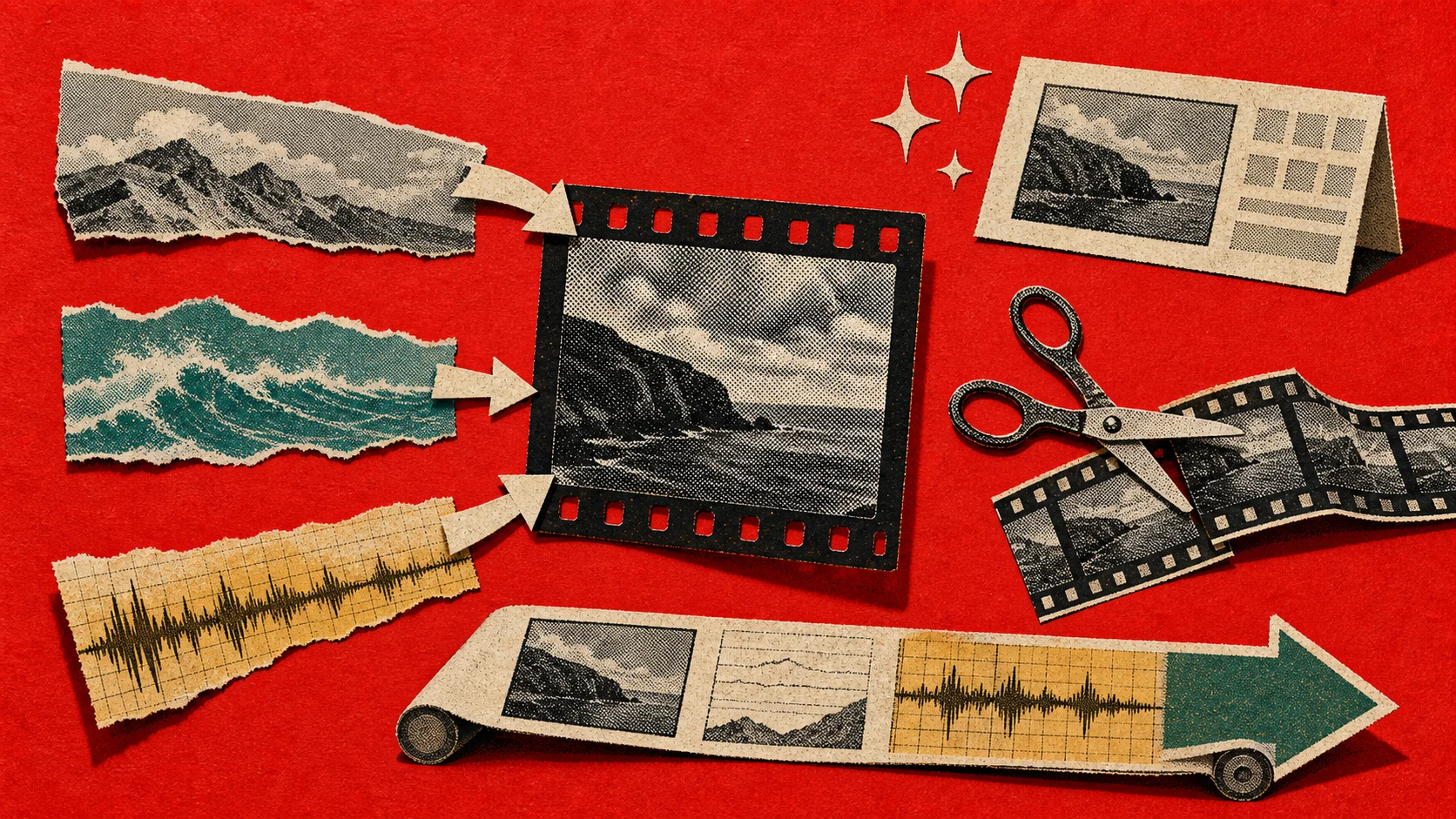
An AI video production platform combines several jobs, such as scripting, generation, editing, voiceover, music, captions, and export. The breadth is useful only when you can still inspect and correct the result.
Before choosing a tool, check five things:
- Starting material. Does the workflow begin with raw footage, a script, an image, or a text prompt?
- Reviewable control. Can you correct individual cuts, clips, captions, audio tracks, and generated shots?
- Continuity. If you need several generated shots, can the tool carry characters, objects, and style across them?
- Export and handoff. Does it produce the required file, or an editable timeline that can continue elsewhere?
- Current access. Models, usage allowances, output resolution, watermarks, regions, and plans change frequently. Check the live product page.
Ten AI tools for creating videos
1. ChatCut: editing recorded footage with prompts and a timeline
ChatCut’s AI video editor works with existing footage. You can describe an edit, work directly from the transcript, and inspect the result in a multi-track timeline. The same project can also add captions, music, motion graphics, images, voiceover, and generated video. It runs as a desktop app for macOS 13+ and Windows 10+, as a web app, and as a plugin for agents such as Claude Code and Codex; it can’t be installed inside the ChatGPT or Claude websites.
This fits interviews, podcasts, talking heads, tutorials, product demos, and other footage where editorial selection matters. The public podcast-to-Shorts example links the source, prompt, output, and limitations so you can assess one real workflow rather than a universal speed claim.
Use the separate AI video generator when the job begins with a prompt or reference image. Generated shots can then be combined with recorded media in an editable project.
Access: the free plan covers manual editing, transcription and captions, with up to 60 minutes of cloud exports in total. Agent requests and generation use credits, and video generation requires a paid plan, from $25 a month or $252 a year. Cloud exports go up to 1080p; 4K needs local rendering on Desktop.
Check first: review every selected moment, removed pause, caption, crop, audio level, generated asset, and the complete export.
2. Runway: generative production and prompted shot changes
Runway Agent can plan and generate images, video, audio, music, and voiceover, then arrange the results in a built-in timeline. Its documentation also describes manual trimming, splitting, and rearranging generated or uploaded media.
For existing shots, Runway Edit Studio uses prompts to restyle footage, replace backgrounds or objects, relight scenes, and apply other visual transformations. Runway documents Edit Studio sequences up to 30 seconds.
Access: 125 one-time free credits, and videos generated on Free carry a watermark (Runway’s free plan details). Standard is $15 a month, or $12 a month billed annually.
Best fit: generative creative projects, multi-shot concepts, and visual transformations inside short clips.
Check first: generated media varies between attempts. Review continuity, rights, audio, and every shot before assembly or publication.
3. Google Flow: Veo-based filmmaking and scene creation
Google Flow combines Google’s generative models in a creative studio. Its current product page lists text-to-video, frames-to-video, ingredients-to-video, extension, video-to-video editing, scene building, an agent, and Veo 3.1 with native audio.
The accompanying Veo documentation describes reference images for characters, scenes, objects, and style; first-and-last-frame controls; scene extension; outpainting; camera controls; and object changes.
Best fit: cinematic scene generation, reference-driven continuity, and projects centered on Veo.
Access: Google’s credit documentation describes daily credits for eligible accounts and more monthly credits on paid Google AI plans. Videos carry Google’s invisible SynthID watermark.
Check first: availability and model features vary by plan, region, and surface. Test dialogue, audio synchronization, character continuity, and the required resolution with your own prompt.
4. Adobe Firefly: generation inside a browser timeline
Adobe Firefly’s Timeline is a browser-based editor with a multi-track timeline. Adobe documents trimming, cutting, text and audio, text-based editing from transcripts, and the ability to generate video or add assets from Firefly generation history directly to the timeline.
This makes Firefly relevant when generation and conventional timeline assembly need to happen in the same Adobe workflow.
Best fit: teams that want browser editing, generated assets, and an Adobe-centered production path.
Access: Firefly Standard is $9.99 a month in the US with 2,000 credits; free accounts get a limited number of generations.
Check first: the Timeline is labeled beta. Confirm current model access, export options, credit use, and whether required finishing tools remain in Firefly or need another Adobe application.
5. Invideo: prompt-to-video production with agents
Invideo’s AI filmmaking guide describes an agent workflow that can write, storyboard, generate, and edit shots from a script, concept, scene, campaign, or film brief. Its current documentation says the workspace routes work across a catalog of video, image, and audio models.
Invideo’s current editor also includes a manual timeline, uploaded footage, multiplayer editing, and color and audio controls inside the same production path. Manual timeline edits don’t use credits; agent work, generation, transcripts and paid stock can.
Access: limited free credits reset weekly. Starter is $20 per seat per month, with 400 credits a month that don’t roll over; an annual offer of $10 a month was showing when we checked.
Best fit: producing a narrated or visual sequence from a brief when scripting, asset generation, voiceover, and assembly need to be coordinated.
Check first: inspect which model created each asset, how credits are charged, what remains editable, and whether stock or generated media fits the rights and visual consistency your project needs.
6. Canva: design-led social video and generated clips
Canva’s AI video generator creates clips from text and adds them to a Canva design for further editing. Canva’s current page describes synchronized audio and a 16:9 clip of up to eight seconds per prompt. Its broader video editor provides trimming, splitting, layers, captions, resizing, animation, templates, and design assets.
This combination fits short social videos, presentations, ads, and branded content where layout and design assets are central to the job.
Best fit: design-led teams and creators who want short generated clips inside an existing Canva workflow.
Access: Canva Pro is $18 a month or $144 a year; video clip generation is listed for eligible paid and nonprofit tiers.
Check first: video generation access and allowance depend on the plan. Confirm clip duration, aspect ratio, usage limits, and the editing control needed for a longer sequence.
7. Descript: editing speech through the transcript
Descript edits video by editing its transcript: delete a sentence in the text and it’s cut from the video. It adds filler-word removal, Studio Sound for voice cleanup, captions, and Underlord, an AI co-editor that can take instructions.
Access: the free plan includes 60 media minutes a month at 720p and 100 one-time AI credits. Hobbyist is $24 a month, or $16 a month billed annually, with watermark-free 1080p. Media minutes and AI credits are separate allowances.
Best fit: podcasts, interviews, tutorials and screen recordings where most decisions are about what’s said.
Check first: transcript edits are only as good as the transcript; check names, numbers and cuts that land mid-word.
8. OpusClip: long videos into short clips
OpusClip takes a long video or link and proposes short clips with captions and reframing for vertical platforms.
Access: the free plan gives 60 credits a month, exports up to 1080p with a watermark, doesn’t include editing, and clips expire after three days. Starter is $15 a month; Pro is $29 a month, or $14.50 a month billed annually.
Best fit: creators repurposing podcasts, webinars and streams into Shorts, Reels and TikToks.
Check first: watch each suggested clip in the context of the full recording. A score from the tool is a suggestion, not evidence that a clip will perform.
9. HeyGen: presenter videos with AI avatars
HeyGen generates presenter-style videos from a script with stock or custom avatars, with a Video Agent, an editor for motion, text and layout, and video translation.
Access: the free plan allows three watermarked videos a month, each up to one minute. Creator is $29 a month with 1080p export.
Best fit: explainers, sales and onboarding videos, and localized versions where a presenter matters more than filmed footage.
Check first: get consent before creating an avatar of a real person, and review lip sync and pronunciation in every language you publish.
10. Synthesia: business and training videos
Synthesia turns documents and scripts into avatar-led videos, with dubbing, brand controls and publishing options built for training and internal communication.
Access: Basic includes 10 Studio and dubbing minutes a month with a watermark. Starter is $19 a month, with a first-month discount showing when we checked.
Best fit: training, onboarding, product education and internal updates that change often and need many languages.
Check first: confirm which business controls (brand kits, collaboration, review) are on your plan.
Also consider
- CapCut for social video on phone, desktop and web, with automatic captions you can correct across devices. Pro is $19.99 a month in the US, depending on your account and region.
- Pictory for turning a script, URL or document into a narrated video. Its 14-day trial exports 720p with a watermark; Starter is $29 a month, or $25 a month billed annually.
- VEED for browser-based caption correction, styling, translation and subtitle-file export.
Can an AI tool make a 10-minute video?
Not in one generation. Video models generate shots measured in seconds; Canva’s clip generator, for example, makes up to eight seconds per prompt, and Runway’s Edit Studio works on sequences up to 30 seconds. A ten-minute video is assembled: recorded footage or many generated shots, plus voiceover, captions, music and graphics, arranged on a timeline.
That’s why the editing layer matters as much as the generator. If you need a long video, choose a tool with a real timeline (ChatCut, Runway, Firefly, Invideo or Descript) and plan to generate only the shots you can’t film.
How to choose without relying on a generic ranking

Use one representative task and score each candidate on the same checks:
- Prepare a short source package: one raw clip, one reference image, one script, and the intended aspect ratio.
- Ask each tool for the same outcome. Keep the prompt and required duration consistent.
- Make one manual correction. Record whether the correction changes a transcript, clip, layer, timeline, or only regenerates the whole result.
- Export a short file. Check resolution, duration, audio, captions, watermark, and playback outside the editor.
- Count the handoffs, failed generations, repeated instructions, and manual fixes. Those are more useful than a feature checklist.
For recorded speech, begin with the editing pass before generating B-roll. For a fully synthetic concept, create and approve a short visual test before building a multi-shot sequence. For a campaign, verify that brand assets, rights, and review steps survive every handoff.
What happened to Sora?
Older AI video lists often recommend Sora as a current product. OpenAI’s Sora page now states that the Sora web and app experiences were discontinued on April 26, 2026, and that the API was discontinued on September 24, 2026. It should not be presented as an available 2026 production choice.
This is why live product documentation matters more than a static ranking. Availability, model names, plans, limits, and editing surfaces can change after an article is published.
Method and disclosure
This comparison was reviewed on October 13, 2026 and expanded on November 4, 2026, when we added Descript, OpusClip, HeyGen and Synthesia, merged our separate AI video tools list into this guide, and rechecked every free allowance and price against the official pages linked in each section. ChatCut publishes this article and is included as one option. No same-prompt or same-footage benchmark across all ten products was recorded for this page, so it does not claim measured speed, quality, prompt accuracy, or an objective overall winner.